
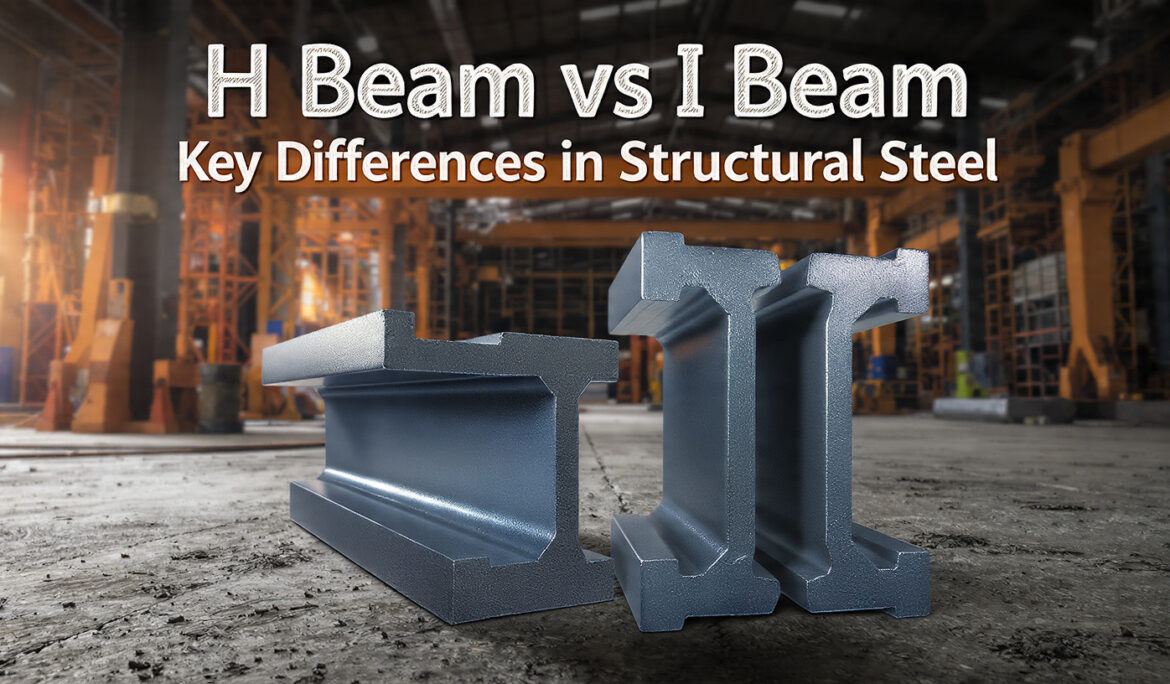
Structural steel beams are essential components in modern construction and engineering projects. They provide the strength and support required to build safe and durable structures such as commercial buildings, bridges, warehouses, and industrial facilities.
Among the most commonly used structural steel beams are H beams and I beams. Although they may appear similar at first glance, they have significant differences in their design, strength, and applications.
Understanding these differences helps engineers, contractors, and builders choose the right type of beam for their construction projects.
This guide explains what H beams and I beams are, their structural differences, and where they are commonly used.
What is H Beam?
An H beam is a structural steel beam shaped like the letter H. It has a wide flange and thick web, which allows it to distribute weight more evenly and carry heavy loads.
H beams are designed to provide excellent structural stability and are commonly used in large construction projects where strong support is required.
Key Characteristics of H Beams
- Wide flanges that provide better load distribution
- Thick web for additional strength
- High load-bearing capacity
- Suitable for long spans in construction
Because of these features, H beams are widely used in large buildings, industrial structures, bridges, and infrastructure projects.
They are considered one of the most reliable structural steel components for heavy construction.
What is I Beam?
An I beam, also known as a universal beam, is another type of structural steel beam shaped like the letter I. It has a thinner web and narrower flanges compared to H beams.
I beams are designed primarily to resist bending forces and are commonly used in construction projects that require lightweight structural support.
Key Characteristics of I Beams
- Narrow flanges
- Thinner web
- Lightweight structure
- Good resistance to bending forces
I beams are often used in smaller buildings and construction frameworks where the load requirements are lower compared to heavy structural projects.
Structural Differences Between H Beam and I Beam
Although both beams are used in structural engineering, their design and performance differ significantly.
| Feature | H Beam | I Beam |
| Shape | Looks like the letter H | Looks like the letter I |
| Flange Width | Wide flanges | Narrow flanges |
| Web Thickness | Thicker web | Thinner web |
| Strength | Higher load-bearing capacity | Lower load capacity |
| Weight | Heavier | Lighter |
| Typical Use | Large structures | Smaller structures |
Load Bearing Capacity
H beams have wider flanges and thicker webs, which allows them to support heavier loads and longer spans. This makes them ideal for large commercial buildings and infrastructure projects.
I beams, on the other hand, are lighter and are usually used in smaller structural applications where heavy load support is not required.
Structural Stability
H beams provide better structural stability because of their wider base and stronger construction.
I beams are more suitable for projects where weight reduction and cost efficiency are important factors.
Applications of H Beam and I Beam
Both H beams and I beams play an important role in the construction and engineering industries. However, their applications vary depending on the project requirements.
Applications of H Beams
H beams are commonly used in heavy structural construction because of their strength and load-bearing capacity.
Common applications include:
- High-rise buildings
- Industrial facilities
- Bridges and flyovers
- Large commercial buildings
- Infrastructure development projects
- Warehouse structures
These beams provide strong structural support and are capable of handling heavy loads and large spans.
Applications of I Beams
I beams are typically used in lighter construction projects where moderate structural support is required.
Common applications include:
- Residential buildings
- Small commercial structures
- Building frameworks
- Floor supports
- Roof structures
Because they are lighter and easier to install, I beams are often preferred for smaller construction projects.
Conclusion
H beams and I beams are both important components in structural steel construction. While they may look similar, their design, strength, and applications are quite different.
H beams are known for their high load-bearing capacity and structural stability, making them ideal for heavy construction and large infrastructure projects.
I beams, on the other hand, are lighter and more cost-effective, making them suitable for smaller structures and residential construction.
Choosing the right beam depends on the load requirements, project size, and structural design. Engineers and contractors must carefully evaluate these factors to ensure safe and efficient construction.
For builders and construction companies, sourcing high-quality structural steel from reliable suppliers is essential to ensure long-lasting and durable construction projects.